
| |
Feb 21
From Leslie: In previous posts, I have shared the message and metaphor behind different body systems and sometimes when we have pain or an illness settle into that part of the body, it is a message that we need to examine how something in that area of our life is out of balance.
So what is it that causes the pain or draws the illness or discomfort to that spot? In my experience in working with energy medicine, it is just that – energy. Energy that has quit flowing. Energy stopped up like a dam builds up pressure and can cause the normal flow of energy to be diverted thus creating imbalance, or just the pressure of built up energy causes pain.
Our thoughts are energy. A thought causes a chemical reaction in the body and thus we feel the thought and we call that emotion. Energy in motion – emotion. Most of the time thoughts, chemicals, hormones, emotions are processed, digested, and let go from the body, but sometimes they stay around and settle somewhere in the body. The place these trapped emotions lodge are because of inherited weakness, or because of that metaphorical message the body is trying to send the conscious mind.
It is easy and fast to identify and eliminate these trapped emotions and get the energy flowing freely again. There are several methods. The one I use currently is from Dr Bradley Nelson and he calls it the Emotion Code. If you’ve got some pain in these areas that we have covered, feet, knees, legs and you would like to explore if you have some trapped emotions there, let me know and we can energy test that before or after class.
Tags: energy psychology, knees, yoga therapy
Feb 18

In Idaho Falls, Idaho
I’ll post more info as it comes, but put it on your calendar
Tags: events
Feb 10
The article that we are drawing from this month on knees comes from Yoga Journal
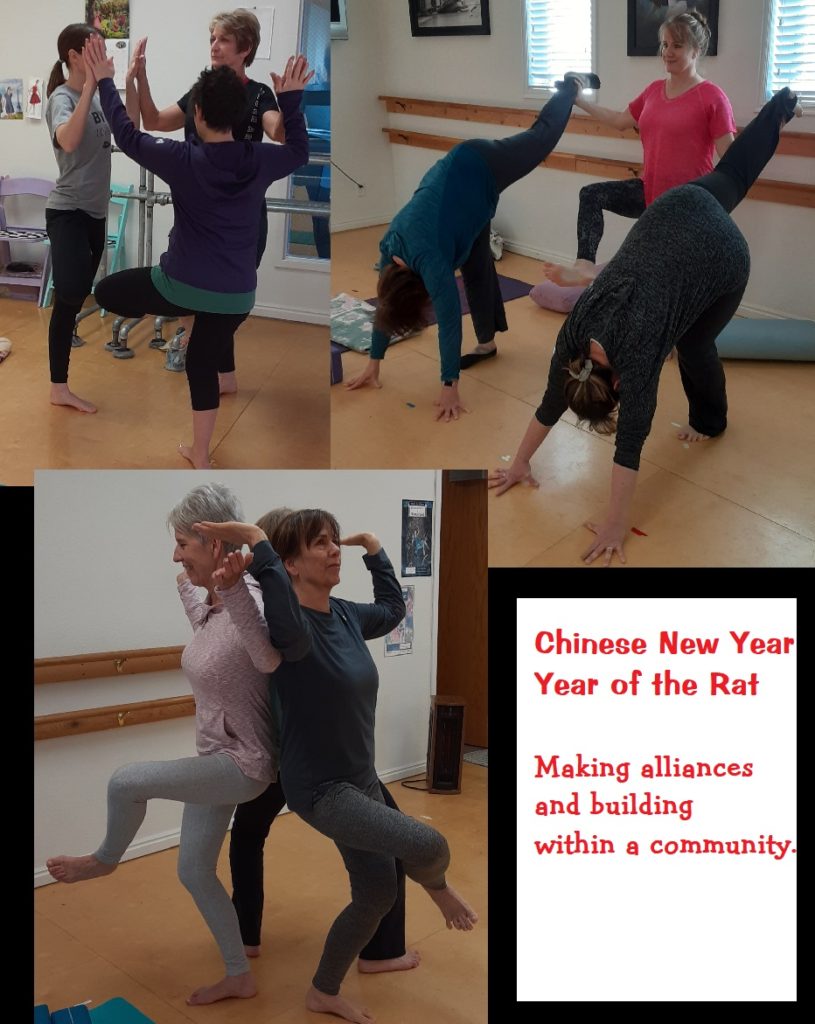
We will be learning and doing chair and eagle pose as our featured poses for the month.
It is possible to injure or slow down healing in the knees practicing yoga. You do that by practicing mindlessly, and without care or by greed. A greedy practice would be wanting to go farther in a pose than is appropriate or trying to look like someone else in the room. In addition to being moderate and practicing with care here are the 8 ways to protect your knees during a yoga practice.
1 Avoid hyperextending. When joints are overly mobile and flex too far back, they’re hyperextended. In the knees, hyperextension often occurs in poses in which the legs are straightened, such as Trikonasana (Triangle Pose) and Paschimottanasana (Seated Forward Bend), putting an unhealthy tension on the ligaments. If you’re prone to hyperextension, keep a slight bend in the knees during standing poses and keep your weight evenly distributed among the four corners of your feet. In seated forward bends, place a rolled-up sticky mat or towel under the knee of the extended leg or legs.
2 Start with your feet. Proper alignment through the feet is the key to building strength evenly in the ligaments on both sides of the knee; when all the ligaments are equally strong, the kneecap glides effortlessly up and down and the cartilage doesn’t get worn down. Separate your toes and press actively through the four corners of your feet in every pose, even inversions. If your feet are out of alignment, your knees are going to suffer.
3 Keep your knees in line. When moving into deep knee bends, such as Virabhadrasana II (Warrior Pose II) and Parsvakonasana (Side Angle Pose), first align your bent knee over your ankle, then draw your kneecap in line with your second toe. Maintain awareness in your back foot, pressing down evenly, while lifting up from the arch of your front foot. “If you let the arch drop, the knee falls inside the big toe, and you’re set up to suffer a number of different kinds of overuse and acute knee injuries,” says Angela Smith, a professor of orthopedic surgery.
4 Tune in to subtle signals. “Oftentimes, the knees don’t give immediate feedback,” explains Iyengar teacher Joni Yecalsik. “Only later do you realize you’ve gone too far. When it comes to the knees, the sensation that would normally proceed the red flag is the red flag.” If you feel achiness when you come out of a bent-knee pose, you may have worked too hard.
5 Build strength by balancing. Balancing poses, especially those that require moving through a bent standing leg, such as Garudasana (Eagle Pose), are especially beneficial. “Very dynamic balancing protects the knee against future injury by training the functional alignment, not just working the muscle,” Smith says.
6 Be prop-friendly. When it comes to seated asanas, nothing makes a tight knee happier than a bounty of props. In Virasana (Hero Pose), try raising your seat with blankets or a block. Anytime the knees are deeply bent, such as in Balasana (Child’s Pose) or Marichyasana III (Pose Dedicated to the Sage Marichi III), pressure can be relieved by placing a rolled-up washcloth as far into the knee pit as possible before bending the joint.
7 Warm up with hip openers. “If your big joints aren’t open, your small joints will always take the stress,” yoga instructor Sandy Blaine says. “Many people hurt their knees doing Lotus when their hips aren’t ready.” She recommends warming up with hip stretches like Baddha Konasana (Bound Angle Pose) and Gomukhasana (Cow Face Pose).
8. Lift the quadriceps muscle on the front of the thigh. This pulls the kneecap right into place and stabilizes the knee joint. Do this in all standing poses where there is a need for that stability but also in seated,reclined and supine poses, so the leg muscles can be strengthened isometrically.
Tags: anatomy, knees, yoga therapy
Feb 08
The focus for Yoga for Optimum Wellness this month is legs and knees. Muscles surrounding the knee joint must be both strong and yet flexible to properly align and stabilize this sensitive joint. Mindfully practicing yoga can accomplish both over time.
A quote from Healing Keys says
Our legs move our body forward and backwards. Our legs symbolize foundation and moving forward in our life.
Problems with our legs signify feelings of not ‘having a leg to stand on,’ with no support, strength or foundation, and having nothing to build on or to go forward toward.
The knees are the shock absorbing joints in the leg. They allow the legs to bend for walking and they articulate with the tibia and the femur.
The knees represent making decisions, charisma and commitment.
Problems with our knees indicate that we are having difficulty with decision-making, that we are ‘weak kneed’ and that we are finding it difficult to move forward in a new way.
We believe that our needs will not be taken care of if we move onto the next step, or that we won’t succeed.
Problems with the knees symbolize trying to get our needs met, rather than fully giving ourselves in commitment, which is truly fulfilling.
Knees represent pride and ego. Problems with knees can be inability to bend, fear, & inflexibility.
The metaphors we use in our language help us to clearly see the energetic message and meaning in our legs and knees:
The problem bought him to his knees,
She is knee deep in tasks,
He went weak in the knees just thinking about the future.
That idea has no legs.
Let’s hit the ground running.
Achieving a balance between strength, but not pride; between flexibility and commitment is the message in the legs and knees.
Tags: anatomy, knees, yoga therapy
Jan 27
Here’s a product to help spread your toes while you are doing something else in the morning or evening.
Tags: recommendations
Jan 14
Yoga tradition teaches that we have a physical body that where we experience and sense the world. We also have an energy body, an emotional body and mental body. All these layers affect each other. Changing one, changes all in some way.
When we have pain or illness in the physical body, its like the warning lights on the dash of your car. Its a signal to examine the energy, the emotions and the message behind the pain.
During the year we will pay special attention to the physical body and become acquainted with isolating a specific system in order to have a more efficient energy flow, thus better health in the physical body.
We also want to learn about the symbolism behind each system. Learning the metaphor and meaning of the feet for example can help us examine and change our emotions and thoughts and again that will change and improve the energy body and the physical body.
In other words – Body, Mind and Emotions, inseparably connected and unified in our yoga practice.
Let’s learn the symbolism of the feet. The message in the feet is associated with the very foundation of your journey here in life; how you are choosing to spend your time, energy and attention. Safety, security and understanding of the world are messages of the feet. Think of the metaphor, landing on both feet or putting your best foot forward. These are statements that the world is secure your path is clear and fortunate.
So when you experience pain in your feet, that is a clue to get quiet and examine your emotions and thought about where you are headed in your journey in life.
Here are some questions to ask yourself in a time of meditation:
Am I moving forward and spending my time and energy where my soul or passion is directing?
If I know I am on the right path, do I feel fearful, lonely disconnected or afraid to move forward boldly?
What can I do to feel safe and secure in the world?
What is the meaning and purpose in my life’s journey right now?
Do I find joy and satisfaction in each metaphorical step?
Are my decisions and commitments wishy-washy or unstable?
Am I filled with fears of falling, fear of failing, fear of the future or just fears in general?
Am I clinging to old hurts, old patterns? (keep in mind that moist, stagnant areas develop mold and fungus)
Am I frustrated or deeply angry with life?
These questions and the strong emotions like fear, anger, inflexibility, loneliness, misunderstanding, unforgiveness all contribute to the physical ailments of the feet.
Ways to hear your inner wisdom are to find a friend who will listen as you speak out loud and then come to your own conclusions. Prayer, meditation, journaling, walking, creative work, or menial work all provide opportunities for your spirit to speak to the conscious mind.
When a thought of suffering or negative emotion is brought out into the sunlight of the conscious mind, it is easy to release and let go. Use techniques taught in your own spiritual practice as well as other energy psychology techniques.
transform mind
angries out
Wholistic healing research
Tags: energy psychology, meditation, yoga therapy
Jan 05
The feet will be the focus in January 2010.
Quick Facts about feet!
The feet are our foundation. In the course of a lifetime we will have walked 115,000 miles, 4 1/2 times around the planet.
The average American takes 8-10 thousand steps a day, equivalent to a force equal to several hundred tons and spanning several miles.
There are 26 bones in the foot, 33 joints and 7,000 nerves.
The American Podiatric Medical Association says, “Your feet mirror your general health. Such conditions as arthritis, diabetes, nerve and circulatory disorders can show their initial symptoms in the feet…”
Here is an article that covers many of the same things we will discuss and practice in class this month.
The Chinese have a saying, “Aging begins in the feet.” Yoga teaches that the feet are the foundation of good posture.
The feet are the body’s workhorses, and without them our mobility, health and well-being are severely limited.
The use of our feet is crucial to postural health. Each day our feet must adapt to the terrain it comes in contact with. On average our feet can absorb up to millions of pounds of pressure. When our feet suffers our whole body suffers.
“Your legs mirror everything you do with your feet. The position of your feet and the distribution of weight though them will affect the position, function, and flow of force higher up through your knees, your hips, and even your back. If your feet are clenched and tight, your whole body reflects this tension too. Because you can see your feet, it is relatively easy to perceive them. Your weight should be equally distributed between the ball and heel of your foot and the inner and outer foot with all the toes spreading to from a wide base of support.” (Donna Farhi)
The remedy for good foot health is to maintain a balanced foundation In the feet while practicing exercises that bring both strength and length to the muscles.
Come to the wall with knees bent and you can see your feet in your line of vision.
Make your feet spacious underneath by elongating the toes and slowly releasing the pressure on the heels so that you can create traction down through the soles and arches. Stay here for several breaths.
Gently press back into the heel to create“fullness” in your foot print.
Warm-up your feet by rolling a racquet ball or tennis ball across the sole of your foot. Work gently into the tender areas. Do this for at least a minute on each foot.
Hero’s (Hero Pose) stretches the top of the foot and elongates the arch, Also stretches the fascial sheath at the font of your ankles, freeing up these muscles and restoring mobility to toes.
Kneeling on toes upright—pull back and bring pinky toe up This pose lengthens the plantar muscles on the sole of the foot, which, when contracted, can become inflamed, leading to plantar fasciitis.
Kneeling Calf Stretch—bring foot next to sit bone and lean forward to open the calf and achilles tendon
Downward Dog– is a good stretch for the arches. Come onto the toes of the feet as high as possible, then extend the heels toward the floor to work the plantar fascia. Spread and extend through the toes to lift arches.
Wide Leg Forward Fold — Our Pose of the Month
Keep inner heels and balls of big toes grounded. Lift the arches of your feet as you draw energy from the ground up through your knees and thighs.
Tree Pose: To practice foot awareness.
1. Establish the balanced action of your right arch, ankle and toes in Tadasana., lift left leg up.
1. Imagine a root extending from each of the four corners of the right foot down into the earth giving your pose great stability.
2. From that root system, lift up from the arch of the foot through the inner aspect of the leg to the pelvis and from the pelvis through the spine to the crown of the head.
3. Notice that the correct action of the foot literally gives you a strong foundation that helps you balance and sets the stage for your pose to grow upward. This article can be found in the May 2002 of Yoga Journal.
Tags: anatomy, yoga therapy
Jan 04
“The whole movement of asana practice should be one toward understanding more deeply the mechanisms that are responsible for our present condition… We learn through the process of conscious movement, to use our bodies more efficiently. In turn, harmonious and efficient movement prevents wear and tear on the system and dissipates less energy. Ultimately, we can change habitual patterns, develop new patterns that decrease physical stress and promote skeletal alignment, mechanical freedom and organic unity, and lead ourselves toward optimum wellness.” Gary Kraftscow
For the upcoming year 2010, the focus will be on improving the function of each of the body’s systems and of those systems’ interaction with each other.
Here is the upcoming schedule for the year:
January – feet and ankles
February – legs, knees
March – Hips
April – Abdomen, low back
May – Heart, lungs, chest
June-Sep – summertime classes
Oct – Arm and hands
Nov – Upper back and shoulders
Dec – Head, neck, face
The first class of each month will be a somatics inquiry led by Shelly. If you have specific questions about alignment or yoga as it relates to that body part, please email us or ask us in class. We want to give priority to answering questions that class members have.
Remember, however, we are not doctors and will give no medical advice for symptoms. We urge you to use yoga therapy as a compliment to the traditional medical treatments you receive for specific conditions.
Our yoga class highlights the fact that we are not only physical beings, but emotional and spiritual beings as well. In addition to becoming more aware of the anatomy and physiology of each area of the body, we will explore the symbolism and energetics of each system during the month.
Our body is able to give us messages about the life journey we travel and when we are unbalanced or traveling down the wrong path. It does that by creating physical symptoms and injuries. So while an illness or injury is not our “fault,” a message is there for us to glean if we will be still and examine where the pain in the body is located and the symbolism in that body system.
We look forward to sharing this amazing journey towards optimum wellness in body, mind and spirit.
Happy New Year and Namaste!
Tags: anatomy, yoga therapy
Dec 10
In class today we recapped the last of the foundation of health: stress. I discussed a book I had read many years ago from Dr. Dean Ornish. I believe the book is called “Dr Dean Ornish’s program for reversing heart disease.” I found it at the Madison District Library and is still available there. The #1 factor in preventing heart disease and in reversing heart disease is having a loving social network.
This loving social network is one way to handle stress. Family, friends, groups, church, classes, teams, are all examples of social networks that we must have if we want total good health. When we are that loving network for others we insure the good heart health of others, when we are fully involved in those groups then they support our own heart health. The important thing here is LOVING social networks.
During these holiday celebrations, if there are occasions where we know we are going to be with people that the relationship is contentious, then now is the time to do whatever we can to harmonize and turn that relationship into a loving one. It might require prayer, forgiveness or another spiritual practice to accomplish that but our own heart health depends upon it. Holding grudges and bitterness gives US heart disease so let those feelings go.
At the end of class I gave a general recommendation that for men it is necessary for them to serve another person and act in a loving way sometimes before they develop the feelings of love. Action first then the feeling comes.
For women, in general, the feelings must come first. So women, do what you need to to first generate the feeling of love for the other person before you serve, that way the service is given from the place of love rather than obligation and resentment. Feelings first then action.
Tags: Foundations of Health
Dec 03
We’ve been sharing this recipe in class, so here it is to look up at home:
2 Qrts half and half or whole milk
2 T live yogurt or 2 packages from the health food store
1 tsp vanilla
The barebones instructions:
Heat in double boiler to avoid scalding. Heat until just below boiling.
Pour into jars and allow to cool until warmish. Add the starter and vanilla and stir into each jar. Culture between 4 and 24 hours using your preferred method (yogurt maker, crock pot, heating pad)
Here is a more detailed version of instructions: Yogurt instructions
|
|
Recent Comments